
Lupita McClanahan's California Visit - The Path of Hozho-Teachings of the Beauty Way In Difficult Times

Updated: Aug 27

Dear Poetic Medicine Friends,
Gathered here are essays, poems, photographs given to me by those who in very significant ways helped with the visit of Diné Elder, Lupita McClanahan from Canyon de Chelly in Arizona to Mountain View and Carmel Valley, CA.
Lupita’s talks, The Path of Hozho-Teachings of the Beauty Way In Difficult Times, brought together many people thirsty for sane, spiritual reflections and direct experience of what it is to live on this earth in a conscious and balanced way.
Her Beauty Way message provided such a helpful, necessary, needed response to those who deny Climate Crisis – and corporations whose primary intention is to harm the earth for profit.
Lupita brought her beautiful presence. The vibrations, the unseen threads of her presence, which surely included the presence of ancestors, caught and wove us all in a healing web of mutuality, in a spirit of community.
She spoke about:
what it means to live on ancestral land
building a bridge between modern and indigenous culture
developing a relationship with Mother Earth and Father Sun
navigating the uncertainty of our current times in a beautiful way
appreciating that living the Beauty Way is about living in balance
These subjects were splendid to hear -- heartening and meaningful. Lupita shared many stories and she illustrated those stories with poetic language and vivid experience.
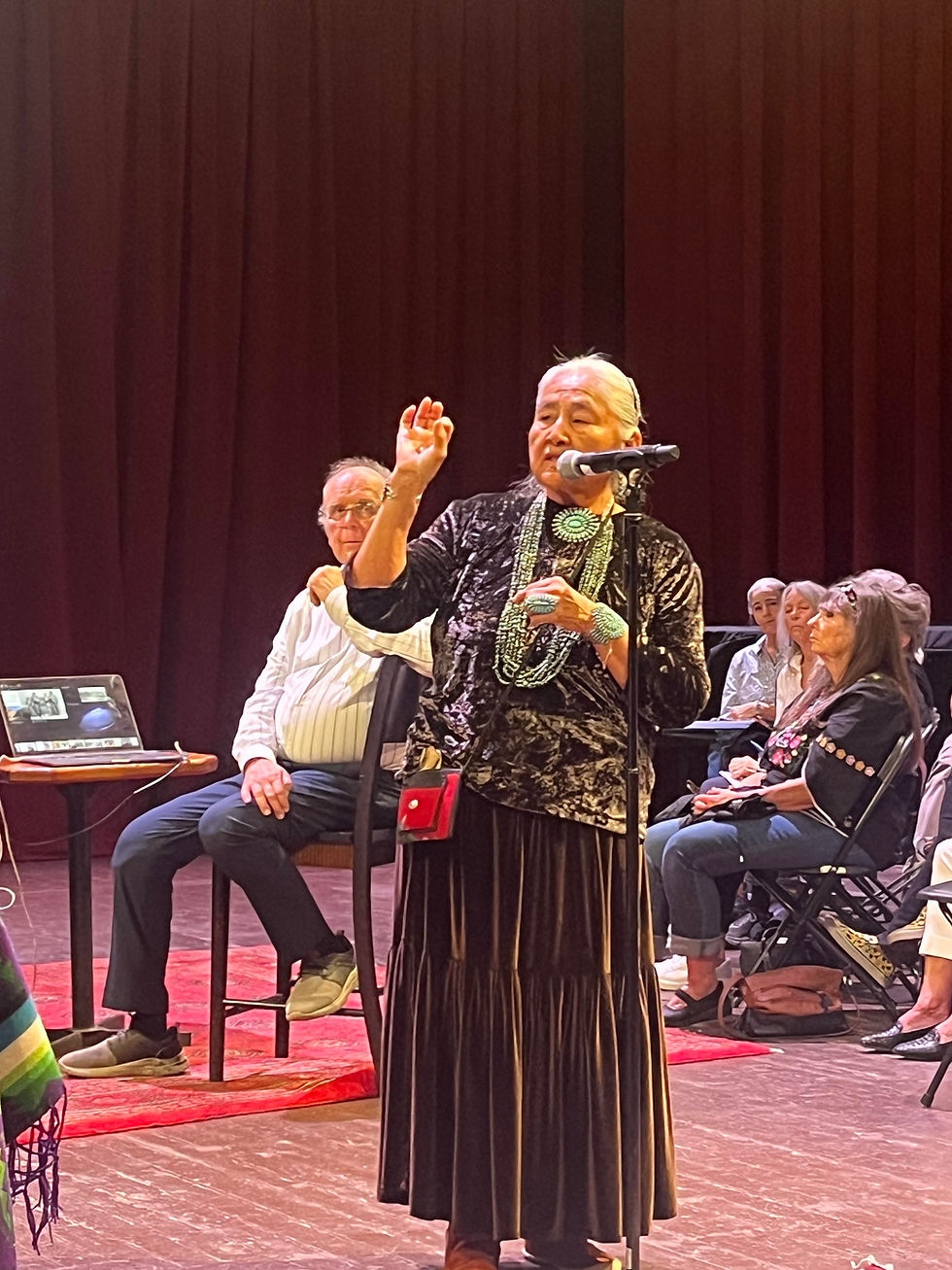
Her perceptions of what it means to have a relationship with Mother Earth and Father Sun were so transparent, so clearly true, everyone could feel it. We heard this – ‘you are not separate from that. You are that!’
It is difficult to get this across – Lupita used her hands, one graced with a turquoise ring and bracelet on her finger and wrist. It appeared as if she was unwrapping these stories as gifts to her listeners.
Although she spoke for two hours, there was a timeless, felt-sense, that made the space sacred and still.
April Johnson, a trauma-informed therapist in Carmel Valley, with her mother, attended Lupita’s talk at Hidden Valley, an Institute for the Arts. April says this about her experience of that afternoon:
I was born and raised in Carmel Valley — this is my sacred homeland, and the Esselen people were woven into the fabric of the community I grew up in. Sitting in that room, listening to Lupita speak of the brutality her tribe has endured, I couldn't separate myself from my own reflection: my white skin, and the ancestors before me who caused this harm.
And yet I watched her stand in front of us with such bravery, open-heartedness, and generosity — gracefully weaving her story into ours, modeling a new way of being. I reached over and took my mother's hand, in a season where my grandmother was transitioning away from this plane of life, and the pain I felt was poignant — poetry offered as medicine, reclamation happening in real time, a room full of people from different walks of life gathering during dire times, reminding us both what it means to be part of community and to look to our elders for guidance.
I thought of my mother's own softness and warrior strength held in the same body, and of Lupita's — that grace and grit have never been opposites. The Beauty Way taught me that part of the work ahead is leaning into discomfort together, letting the walls between us come down, and reweaving, rewriting, and reclaiming something sacred, together. (See full essay by April Johnson:)
April’s sense of the grace and grit of her mom, this life-time intimate connection to her mother and yet in this met-for-the-first-time Diné Elder – in whom she could also feel and recognize grace and grit, it makes me wonder about the permeability of time and the timeless.
Lupita was raised in secrecy by her clan’s medicine people so that she could avoid the boarding schools and keep her culture alive. She is perhaps one of the last Indigenous Diné of the American Southwest raised in the traditional way, by traditional elders, who still lives on her ancestral land.
I am grateful for and I celebrate the sharing of these essays and poems written by Bob Steinberg, Marie Boucher, Elizabeth Sanders and myself. These essays were written at my invitation much earlier this year.
Each had, as I say, a significant place in supporting this visit by Lupita. Their essays are insightful, evocative, textured and yes, beautiful.
Lupita previously met Bob and his wife Janet over a quarter century ago when they journeyed to Canyon de Chelly for a poetry workshop with me. She met Elizabeth at Canyon de Chelly last year. Marie Boucher met Lupita on the occasion of her visit.
I met Lupita and her husband Jon in the late Spring of 1997. You can read more about this long-time connection with Lupita in my Introduction I gave for her in both Carmel Valley and Mountain View. She wrote the poem Creator during one of my visits bringing poets to Canyon de Chelly.
I hope you enjoy this collection from these marvelous people.
Kindness,

Table of Contents
Bob Steinberg
Marie Boucher
Elizabeth Sanders
John Fox
Russell Evans (with Lupita and Jon McClanahan)
April Johnson
Lupita McClanahan, Dine′ Elder from Canyon de Chelly
Presentation at Hidden Valley Institute
in Carmel Valley on January 19, 2026
by Bob Steinberg
Early in May of 2001, my wife and I signed up for a poetry writing retreat led by John Fox in Canyon de Chelly, Arizona, the ancestral land of the Dine′ (Navajo) people. We came to know John Fox, author of “Poetic Medicine”, from an inspiring poetry workshop we had taken many months earlier in Northern California.
Sponsored by Footpath Journeys, a variety of tours and hikes in Canyon de Chelly are offered to organizations as well as the general public by Lupita McClanahan, a Dine′ Elder, and former park service ranger.
During our retreat, Lupita provided us with a wealth of information about the Navajo (Dine’) culture and their longstanding traditions. She also educated us about the painful and tragic early history of the Navajo people who were taken away from their ancestral land by colonizers, and whose young children were later forced to go to Catholic boarding schools to be indoctrinated.
A focus of the tour was to develop a relationship with “Mother Earth and Father Sky”, and to experience through daily hikes the sacredness of the land. Day after day, we were guided to very special spiritual sites in which such ancient history and grandeur led us to express our experiences through poetry. We were captivated by such beauty and rapture.
One of my most touching experiences led me to write “Spider Rock Prayer”, an ode to the “Ancient Watchtower of the Dine′, cast in mystery and legend…”. You can read this poem following these essays.
Fast forwarding many years later, thanks to the success of Footpath Journeys’ promotional video, Lupita and her husband Jon were invited by the Olympic Committee to represent all Indigenous people at the Olympics. They were sent to Half Moon Bay, California to have their video edited for this purpose. This led to our invitation a few days later for them to stay at our home in Carmel Valley, just a few hours south.
Carmel Valley is a beautiful village and is only miles from the coastline. Thus it gave my wife and I the opportunity to introduce Lupita and Jon to Point Lobos, one of the most magnificent marriages of land and sea on the planet.
This was the very first time for them to see the ocean, “The White Shell Bead Woman” as the Dine′ would say. With tears in her eyes, amongst the tide pools and vast ocean of Point Lobos, Lupita stood silently offering a blessing.
After spending three very special days with Lupita and Jon we knew our bond would never be broken, and we kept in touch for over 15 years.
But as life would have it, we did lose touch. Eventually our phone calls were not being answered. We were worried and did not know what had become of them. Two years, maybe three years went by, and then on June 4, 2025, I received a promotional email from Footpath Journeys. I was informed that Lupita would be going on tour in several cities around the country, speaking on “The Path to Hozho-Teachings of the Beauty Way in Difficult Times”. What caught my attention was a tentative schedule for a talk in San Francisco in mid-January of 2026.

I was excited. Lupita is not only well, but she is travelling to various destinations to share her wisdom and invite conversations. Although I have no experience in promoting such events, my love for Lupita motivated me to try to set something up in Carmel Valley. It galvanized me to somehow find a way to make it happen. Furthermore, I live in a community with a long history of indigenous people having thrived here. Both the Esalen and Rumson tribes still have members living on the Monterey Peninsula, and their territory has spanned from the Monterey Bay down to the Big Sur coast as well as to the Santa Lucia Mountains.
Slowly but surely I made connections. First I communicated with John Fox who also was trying to set up a talk for Lupita, hopefully in Mountain View on January 17th. Then I asked if any of the 10 members of my Shakespeare group personally knew any indigenous people.
Then I spoke with a contact that was passed on to me from Lupita, Liz Sanders, who is involved with the Wildlife Conservancy and who had multiple associations with Indigenous people. But time was running out since Lupita had scheduled talks in Oregon starting at the end of January and return flights back to Arizona needed to be made to plan for those trips.
So, I was about to give up a few days before those flight arrangements, but I had a last-minute breakthrough. One of my Shakespeare group colleagues referred me to Marie Boucher, the Poet Laureate of Monterey County. Marie is a poet, educator, peace advocate and naturalist, and she is steeped in promoting the county’s rich cultural heritage, especially the indigenous community.
So with only days to spare, I set up a meeting with Marie and her architect partner, Rod Mesquit, a 7th generation Rumson descendant. The three of us clicked, and given her extensive mailing list my confidence was growing, and I decided to commit to holding the event.
But the venue was still up in the air. We all agreed that the best location would be Hidden Valley, an Institute of the Arts, internationally famous for Music and Dance seminars and performances, yet only 5 miles from my home.
So, coyly I called the Director of this fifty-year-old institution, Peter Meckel. Not only did he welcome my call, but once I described Lupita’s background and her noble purpose in offering these talks, Peter not only agreed to open up his 250-seating capacity theater for that Monday, but he so graciously waived any fee.
What a gift! And, as a bonus, he agreed to promote the event on Hidden Valley’s mailing list.
Next step was help from John Fox. John had already secured a smaller venue for a talk in Mountain View California on the 17th, and he asked his friend, a graphic artist, to design a promotional brochure for that presentation. He was kind enough to have a similar brochure generated for us to also promote the Hidden Valley event on the 19th.
I had a few more contacts to make, and some additional ideas to pursue to try to hit my personal goal of 100 attendees. First, I contacted the Footpath Journeys communicator, Russell Evans, to send out an alert to all of those on his mailing list, some of whom who had already signed up using the link on the brochure. The idea was to remind everyone that entry to the event was free (although donations were welcome), and that there was no limitation on seating.
My next step was to contact a friend of mine who was a docent at Point Lobos. He agreed to announce the presentation by including the brochure in the docent’s newsletter, a mailing list of 125 members. I further left Lupita’s promotional brochure in restaurants, libraries, coffee shops and groceries. And finally, I decided to run a large ad in our most popular local online and printed newspaper, the Carmel Pine Cone.
So, with Marie’s mailing list, Hidden Valley’s mailing list, the Point Lobos docent mailing list and the large advertisement in the Carmel Pine Cone, I felt we had a chance to hit 100 attendees (perfect, since 150 chairs are already permanently set up as tiered seating at Hidden Valley). Just in case I underestimated, I also arranged to have 50 folding chairs set up at the theater as well.
Well, the day finally arrived, and the event would start at 3:00 PM. It is the third day of a three-day weekend. Monday, January 19th is a national holiday, Martin Luther King Jr. Day. With some people off from work and possibly even tourists who might see the brochure around town, I thought “who knows” how many folks will show up?!
John, my wife Janet, Marie, Rod, Lupita and I all arrived early. We had the audio-visual manager test the microphone and the projector for the 10 slides to accompany Lupita’s talk. Shortly thereafter, people started coming in through the two theater entrances. The crowd starting growing…and growing…and growing.
Soon, all 150 tiered seats had filled up. Then the 50 extra folding chairs started to fill up. Then I got worried and I asked for volunteers to help assemble the remaining 50 additional chairs that had been set aside. That help was needed since all but three of those chairs became occupied.
We ended up with 247 attendees, just three short of the venue’s capacity! When Lupita started her presentation, the audience was spellbound. She spoke for two hours of the “Beauty Way”, about living in harmony with nature, about building a bridge between modern and indigenous culture, and developing a relationship with “Mother Earth and Father Sky”. Her strength and beautiful character shined through during her entire talk and, no surprise, she received a standing ovation upon finishing.
In closing, I feel blessed that she came to Carmel Valley and that she touched so many people, especially given that we are living in such difficult times. Her spirit will remain in this community and will endure long after she has returned home.

Reflections on “The Path to Hozho-Teachings
of the Beauty Way in Difficult Times”
by Marie Boucher
Our hearts are still full with gratitude for the teachings of Elder Lupita, who shared about the Hohzo Beauty Way with the community gathered at Hidden Valley, Carmel Valley, CA. Elder Cari Herthel, of Rumsen-Esselen descent, offered the welcome and acknowledgement of native land, reminding us that the land blesses us.
Lupita introduced herself from her maternal and paternal clans and her relationship to her homeland of Tse’gi or Rock Canyon (Canyon de Chelly). She shared from a deep knowing of her place of origin in the canyon--from where the handholds are in the red rock she has scaled since she was young to stories of pregnant women ascending the rock face to reach the birthing hogan, sometimes with the child arriving along the way. She affirmed that people belong to the land, not the other way around.

When she spoke of time, it was not in a linear way, but in a holistic way, always referencing the Beauty Way, speaking about how one lifetime is “like a dot on the canyon wall” and that “humans are no more important than lizards.” We must remember during our time here to be walking in the Beauty Way.
As we leaned in to listen to her stories, we learned more deeply about what it means to walk in Hozho, the Beauty Way. Hozho, as defined by Lupita, is a way of being in relationship with Earth and with all beings, a way of consciously walking with courage, clarity, and respect.
She described the Dine’ worldview that when they arrive on Earth, they come with corn pollen on their tongues, and are taught “not to abuse the tongue” as the corn pollen is sacred. She spoke of starting the day by meeting the dawn in the East with prayers and gratitude.
Lupita acknowledged that life brings many struggles, for which we need to prepare ourselves physically, emotionally, and spiritually. She spoke of the importance of walking in beauty, acknowledging Beauty all around, Hozho, to meet the challenges with strength and courage.
In the Canyon, if someone “forgets how to pray,” they are told to go to Spider Rock, where they can remember the lessons of Spider Woman (Na'ashjéii Asdzáá), who first wove the web of the universe, reminding the Dine’ of the Beauty Way and that all life is woven together.
Lupita has been generously sharing her message of “Walking the Beauty Way in Difficult Times” to various communities across Turtle Island, so we all can remember the importance of speaking to others with respect and care, as if we had “corn pollen” on our tongues. We all need to honor the places we inhabit, treat all beings and the land as sacred, and when we forget to speak with kindness or respect, we are encouraged to remember this essential message of walking in Hozho, the Beauty Way.
Beauty Way for the Woman with the Brown Horse
by the Woman who lives in Hidden Hills
You came to see White Beaded Shell Woman
from the belly of the Earth, from your canyon,
where thousands of tears have been shed
for those lost during the dim-lighted years,
And now, we are blessed with your stories--
how the women climbed the mountain to birth
their babies in the birthing hogan on the mountain,
or on their way, or on a horse, however the child
was meant to arrive in this world.
We are so grateful for your sharing of Emergence,
this sacred time of the coming into being of
humans from the earth and the beginning
of stories. Of course, the earliest time is that of
the first stories around the fire from the belly of the Earth.
You bring us medicine from your land of red rock.
We greet you with abalone and calls from the sea,
from White Beaded Shell Woman, who knows you,
as She resides in your veins, and is the one who helps
You climb the mountain over and over again.
We are humbled by your path, the Beauty Way, and how
You stand up in hard times, only allowing yourself to cry
for 4 days for the loss of a loved one, how the canyon
holds your grief, but the children need your joy.
Ya'at'eeh..grateful for the messengers, the hummingbirds,
lizards, all creatures who reside with You. We know them
by their names here, too, but we tuck ourselves in
comfortable houses with artificial heat and conveniences,
And so, we grow more distant from their stories and our own.
Your babies are placed in the middle of the universe
between two rainbows, to remember their place,
to know that they are sacred. And, if doubt falls,
Spider Woman is there to weave her web, so they may recall
the original stories, as She is present to them all.
You taught us not to abuse our tongues, that your people
are born with corn pollen on their tongues, and this reminds
them of their sacred responsibility. When there is ceremony,
ritual, and daily reminders of the sacred, one can
walk taller on the Hozho Path without faltering.
We are grateful for your lesson and example.
We do not know how many generations it will take us to learn,
but we’re practicing step by step. Perhaps, if we go up and down
our mountains, learn how to speak to coyotes and sage,
then maybe, we’ll grow closer to this knowing, and remember
to greet the day in the East with reverence and say:
“Thank you, Creator. We are blessed to be here today,
another day on the Beauty Way.”
My time with Lupita, The Girl With The Brown Horse
by Elizabeth Sanders
I started a business last year, Coyote and The Magpie, hoping to encourage others to connect with nature on a deeper level. I firmly believe that we need to inspire love in order to protect this planet. Our modern culture holds a fear for the unknown and that has separated us from the natural world. Some no longer feel a part of it, rather like the planet is something to control.

I’ve spent years hiking, traveling and backpacking all over the world, in remote and not-so-remote places. After completing an awe-inspiring trip to Bears Ears National Monument, leading an amazing group of women up and down impressive canyons full of artifacts, I found that I wanted to find a way to uplift the voices of this land. I wanted to invite people to hear their stories...stories that have been muted for too long.
That's what led me to Lupita McClanahan. Through the Canyon de Chelly tribal directory, I found exactly what I was looking for. An accessible way to bring everyday people into an important Diné homeland. A Diné elder with open arms willing to tell the stories of her people and herself. She offers the only way to walk down traditional paths to her home in the canyon.
A way to connect with feet touching the earth, with the added bonus of giving your camping gear a ride to the bottom ahead of you.

On my first trip to see her last September, she led our group past exquisite cliff dwellings, rock art of her people and others while telling important historic accounts. I’ve never known someone more comfortable in their own skin, and on their own feet.
While on her homeland for 4 days and 3 nights, we learned games and traditional uses of plants and walked ancient footpaths. Most importantly to me: we heard her voice, in her language, and listened to her speak to gods and kin that she respects and loves. We witnessed that deeper connection so sought after and I can’t wait to visit her again and learn more.
Coming back to roots,
the good earth underfoot.
Speaking and LISTENING
for the heartbeat that sustains us
The beautiful pulse of life
we’ve learned to step away from,
as if separation were surivival,
as if silence were safer than knowing
The key to understanding is communication:
with elders who walked before us,
with new life still learning their voice.
With rocks that remember,
trees that translate wind into movement,
water that carries every story forward
With gentle prairie breathing wide and slow,
and the highest mountains
holding up the sky.
The good earth is always there.
She waits for us
to come home.
~ Elizabeth Sanders
Lupita McClanahan – An Introduction
by John Fox
When I wrote Poetic Medicine in nineteen-ninety-six, thirty years ago, I made a conscious choice for the first poem in Chapter One, Heart, Who Will You Cry Out To, to be a prayer by a Navaho. (Now I know to say Dine.)
I knew that although I was part of the evolution of poetry therapy as a clinical practice, as an expressive healing art of incomparable value, I knew that this did not do justice to the actual origins of poetry-as-healer, to language having the power to heal and transform life, to recognize it as sacred, to celebrate it. Here is the poem:
I ask them with reverence,
of my mother the earth,
of the sky, moon, and sun my father.
I am old age:
the essence of life,
I am the source of all happiness.
All is peaceful, all in beauty,
all in harmony, all in joy.
~ Anonymous Navaho
That poem/prayer is recognized in my heart as belonging to Indigenous peoples. That is where poetry as healer belongs, where it begins and where it has stayed over eons. I was offering Poetic Medicine with reverence.
It was in 1997, soon after the book was published, that I had the great good fortune to meet Jon and Lupita McClanahan living in Canyon de Chelly. They were for REAL, Diné people, who served as our guides when I brought a group to write poems in this sacred place.

A place and people, Jon, Lupita and their family, including Lupita’s mother, I was meeting for the first time. That meeting and the friendship that followed is one of the most beautiful gifts of this life.
For the next twelve years there was collaboration between Footpath Journeys and The Institute for Poetic Medicine. I brought groups of people, between 10 and 20+ to not only write poems, but to camp, create a kitchen, share meals, establish community, sit in fire circles at night under moon and stars, walk that sacred place and experience Lupita and Jon’s wisdom, humor, caring, inclusivity and presence.
We experienced the creativity and inspiration that arose in our poems, the way a visit to the sacred site of Spider Rock settles into the heart forever, the simplicity of our day, disconnecting from the world, the fierceness of the wind, touching your hand to the ancient rock art of a hand, meeting neighbors like the ancient sheep herder Marie and the amazing jeweler A. C. Henry, being quiet together around the warmth of the evening fire.
This is what she brings to us this evening – wisdom, humor, caring, inclusivity and presence. Since I met her, Lupita has shown me this: she is a carrier of, a bringer of Hozho. Her life and how she lives this life is Hozho.
She has lived her life at Canyon de Chelly. She specifically chooses to live now on her ancestral land. There is no running water or electricity where she is. Her contentment is strong. Her commitment is strong.
Now, that contentment and commitment is moving her to create at Canyon de Chelly that can be a PLACE for the next generation to of indigenous peoples to gather and share, to learn and stay close to the culture of the beauty way.
This is a big and astonishing plan! Russell Evans is helping Lupita to manifest this expansive vision: Now, with that contentment and commitment – and with a sacred call she has received – a multi-layered story that is so inspiring that I can’t go into detail about here – she is traveling the country – Idaho, Missouri, Seattle, Portland, Boston and more -- to reach out to others, to help us to consider how the Beauty Way can show, in these difficult times, a way to walk in balance, to walk in beauty.
The Spirit of Tse Gi*
In the canyon I know where I am,
sleeping on the ground,
starry sky gone — grass sparse.
Night wears handmade clothes,
the woven work of her own hands.
She walks with a shawl pulled around her,
hides herself this way —
not out of fear but respect
so she can think of her family in the immense
and private silence that surrounds her,
as her feet stir the wind loud on her way home.
I know where I am here, close to
the wind, to the fringe of silence, close
to sacred space, to Night,
alive. Here at the end of the universe,
she arrives home, sits on earth close to stars.
I know where I am in this canyon
blessed by the Being that walks
in fidelity with the winds roar,
where I release myself to what is large,
and what is small, tucked
into the cleft of Tse Gi’ living prayer, settled
into the quiet mind of the One who walks home
so assuredly, thinking of family,
the one who is humble and great,
who breathes Spirit in and out.
Footpath Journeys: The Steps Ahead
by Russell Evans with Lupita and Jon McClanahan
I wanted to share an update with all of you about Lupita, John, and where Footpath Journeys is headed. To understand the big picture, we need to start with our ultimate goal: finding a way to preserve traditional Diné culture while building bridges to the modern world so that the wisdom of Lupita’s ancestors can be shared for generations to come. The first part of this is straightforward: ensuring Lupita and her family are stable. Booking more hiking tours, organizing speaking engagements, and securing a permanent, modern home on the land all build economic and social stability.
We’ve made remarkable progress on this front. We’re nearly done with her home at Sheep Camp, her hiking tours are fully booked, and there’s great interest in another speaking tour this coming winter. While it will take a few more years to pay off debts like truck payments, they are overall in a better position than they’ve been in decades. At the same time, it’s vital to build bridges to the modern world so her knowledge can be passed on—including to her own relatives, who face the rapid loss of their indigenous roots. We’ve worked toward this by expanding our Cultural Immersion Tours.
The revenue doesn't just support Lupita; it's shared with her relatives in exchange for singing songs and sharing cultural traditions. This is essential because job opportunities on the Rez are scarce, especially work that honors the culture. When people can make a living preserving their heritage, they keep it alive. When they can’t, the culture fades. Looking ahead, our dream is for Lupita to pass her teachings down to the next generation, most likely through an apprentice within her family.
While Footpath doesn’t yet have the capacity to host an apprenticeship program, completing John’s Grandfather’s Cabin brings us one step closer. By creating enough shelter at Sheep Camp, we can host visitors across more seasons. This increases work and revenue, making it feasible to employ team members full-time who can learn from Lupita while helping run the tours.
Perhaps the most beautiful part of this effort is bringing people from the modern world out to the Rez to help build this infrastructure. The majority of the funding and labor for Grandfather’s Cabin has come from teenagers in Montrose, Colorado—kids who have met Lupita and want to spend time with her on the land. In the years ahead, we hope to continue using these projects to bring people together for the greater good. We look forward to sharing this journey and growing together with all of you.
Russell Evans
with Lupita and Jon McClanahan
Russel Evans and Canyon work crew The wood brought in to Black Rock for building the house Building the house at Black Rock Jon and Lupita on the porch of their home
These photos are a slideshow. Clicking on the right side of them will allow you to see the other photos. Scrolling over them will let you read the captions.
Walking in Beauty: On Reclamation, Movement, and the Stories We Carry
by April Johnson
I grew up believing that healing was something you fought your way toward — that you had to be strong enough, first, to earn it. It took me most of my life, and a great deal of trail, to unlearn that.
This January, I sat at Hidden Valley in Carmel Valley, and there was a felt presence in the room — true, directed attention, like flowers turning toward the sun. Lupita McClanahan, a Diné elder from Canyon de Chelly, was speaking about the Beauty Way — Hózhó. She was raised in secrecy by her clan's medicine people so she could avoid the boarding schools and keep her culture alive. She spoke of the handholds carved into the red rock of the canyon, worn smooth by generations of women climbing toward the birthing hogan — sometimes, she said, a child arrived along the way. She said something I haven't stopped thinking about since: people belong to the land, not the other way around.

John Fox, of the Institute for Poetic Medicine, spoke after her. He talked about language having the power to heal — not as a clinical technique borrowed and applied, but as something older and more sacred than that, something poetry has always been doing long before any of us called it therapy.
I've been writing poems since I was about ten years old. In high school, I ran track, took my first psychology class, and was introduced to new ways of writing poetry, all in the same stretch of years — three separate rooms, three separate teachers, but somehow the same lesson underneath all of it: pay close attention to what's true, and find a way to move it out through your body, or say it, or write it down. Those three things have never really separated since. They just expanded into the rest of my life.
One of my earliest teachers wasn't a person at all. When I was fourteen, I rescued an abused horse named Dynamite. She taught me things about fear and trust and the slow work of earning safety that I wouldn't have language for until years later, in graduate school. Long before I opened my private practice, I spent years doing equine-assisted psychotherapy work with a nonprofit collaborative — watching, over and over, how a nervous system can learn to trust again in the presence of an animal who asks nothing of you but honesty. Horses taught me. Trees, too, if I let myself slow down enough to notice. I don't think of humans as at the top of some made-up hierarchy. I think we're part of a much larger conversation, one that was already happening long before we showed up to it.

As a therapist, I've come to believe healing isn't really found by pushing forward — it's found in surrender. In going inward instead of around. In releasing the illusion of control. Our feelings are teachers, not problems to manage; a trigger is often a guide pointing straight at the place that still needs tending. Our past — not just what happened, but how it wired us — shapes the unconscious patterns we run on every day, the circuitry beneath the beliefs we didn't choose. Understanding that past is how we get to rewrite it. And here's the part I keep coming back to: we are wounded in relationship, and we heal in relationship, too — with ourselves, with others, with the parts of us that never got to be young without fear. We have to re-parent what got hurt. And we have to do it inside community, not alone. The art of being present, and the healing power of silence, are part of that same practice.
That belief is what carried me through my own reclamation journey — the Mountain to the Sea 100-miler, a three-day run connecting the sacred mountain ranges from Big Sur to Monterey, from the peaks I grew up under to the ocean. I didn't run it to prove I could finish something hard. I ran it because I'm a trauma survivor, and running has always been one of the most honest ways I know to move what my body has been carrying. Those three days were community-supported the whole way — including by five women who have become my chosen family, the kind of friends you find when you choose hard things and keep choosing them, together.
And when I get lost, it's the land I go to now, more than people. Mother Earth has taught me what unconditional love actually feels like — to be held and fully seen, without masking, without performing. My own mother gave me that entry point long ago, in the deep respect she carried for the land, its creatures, and Indigenous ways of being she herself honored. Somewhere along the way, I started to see life the way she quietly modeled it: not a straight line, but a tapestry — wounds and recovery woven together, ebbing and flowing like the ocean.
Choosing joy on purpose, in the middle of a world built for speed, is not naive. It is an active resistance. It is the whole practice — the one Lupita named, the one my mother lived, the one I now try to hold open in my own private practice, Wild Heart Therapy. Mostly, people come to be witnessed. I walk alongside them as they unearth their own true potential — some come to run, some come to grieve, some come simply to remember they belong to something larger. I try to meet them the way that room met Lupita — fully, quietly, present.
Bob Steinberg is a business owner who enjoys tennis, hiking, biking and skiing, and is an active member of the the ski club. He has a creative spirit and delights in challenging home projects. He has two Bachelor’s degrees from Rutgers. He is the author of The Triple Play of Business: A Strategy for a Healthy Company. He is married to the artist Janet Steinberg.
Marie Boucher is the current Poet Laureate of Monterey County (2026-2027) and Assistant Professor at the Middlebury Institute of International Studies at Monterey (MIIS). She co-leads the annual International Poetry Week and monthly International Poetry Gatherings in Monterey. Marie Boucher is the Editor-in-Chief for Doves Born of Flames: Poetry of Resilience from Many Lands, a multilingual anthology dedicated to peace and justice (2026), and her upcoming personal collection Becoming River (2026), and chapbook, Renaming the Stars: Poems for Gaza (2026).
Elizabeth Sanders is a student of ethnobotany and teacher of regenerative agriculture. She is the founder of Coyote and the Magpie. Elizabeth says: “My dream is to help facilitate strength and independence in others while encouraging a mindful path.” The mission of Coyote and the Magpie: “We provide educational hiking and backpacking adventures that make the outdoors more accessible. Nature is healing, and we have so much we can learn.” https://www.coyoteandthemagpie.com/about
John Fox, Practitioner of Poetic Medicine, is a poet, educator and author. His books include Finding What You Didn’t Lose: Expressing Your Truth and Creativity through Poem-Making (1995) and Poetic Medicine: The Healing Art of Poem-Making (1997). His work is featured in the 2008 PBS documentary Healing Words: Poetry & Medicine. He is the founder in 2005 of The Institute for Poetic Medicine, a nonprofit that serves people at the margins.
April Johnson, LCSW, is an eco-trauma therapist in Monterey County whose practice, Wild Heart Therapy, weaves movement, nature-based healing, and reclamation into trauma recovery — helping people connect with mind, body, and spirit, and giving voice to their own stories. If you'd like to learn more about April and her practice, you can learn more about her private practice at apriljohnsonlcsw.com.


Comments